- home
-
Products
- Products
- Metrici Custom Applications
- Metrici LPR
- Metrici LPR Parking Module
- Metrici LPR Toll Station Module
- Metrici LPR Weighing Module
- Metrici PPD
- Metrici Area Counter
- Metrici Line Counter
- Metrici QR Code Reader
- Metrici Container Code Recognition
- Metrici Thermal Analyzer
- Metrici Parking Terminals
- Metrici Smart ID Scan
- Metrici Car Kit
- Metrici Server Systems
- Metrici Observer Radar
- Metrici LED Display
- Metrici MultiController
- Metrici LAN Controller
- case studies
- Applications
- Resources
- news
- videos
- Contact
AI Solutions for Transport & Logistics
Automate vehicle identification.
Monitor operations.
Improve logistics efficiency.
From truck arrivals and departures to weighing operations and loading areas, Metrici turns the camera infrastructure you already run into an automated record of every vehicle movement — plate, weight, dock and dwell time — flowing into the systems your operation already uses.
Vehicle recognition at the gate
Weighbridge automation
Access control
Logistics monitoring
Works with existing IP cameras, where suitable
Open HTTP POST / JSON integration

The challenge
Manual vehicle processing is where time and cargo disappear
A depot runs on a handful of numbers: how long a truck is on site, whether the load matches the paperwork, which dock is free next. In most yards those numbers are produced by a guard, a weighbridge operator and a whiteboard — and they stop being reliable the moment the shift changes.
The gate runs on paper
A guard writes plate, time, driver and cargo by hand, often after the truck has gone. Illegible entries, missing rows and re-keyed data mean the arrival record is neither complete nor timely — and the queue at the gate keeps growing while it is written.
Weight is recorded, not verified
The scale prints a ticket and someone types the plate next to it. Nothing compares the weight coming in with the weight going out, or with the cargo that was declared, so losses, theft and mis-declarations surface weeks later in a reconciliation — if at all.
The yard is invisible
Which docks are free, which trailer is where, how long a bay has been blocked — this is answered on the radio. Drivers circle the apron, trailers get spotted twice, and dwell and demurrage climb without anyone being able to show where the time went.
Operations data arrives late
The TMS, WMS and ERP are fed by an end-of-shift spreadsheet. There is no per-vehicle record to bill a carrier against, no evidence when a driver disputes a wait time, and no baseline to plan next month's inbound slots.
The Metrici solution
One platform from gate to scale to dock
Metrici develops its own video analytics engines in Bucharest. They run side by side on the same video feed, share one database and expose every event through one open interface — so the camera at your gate also produces your weighing record, your yard occupancy and your audit trail. Metrici can work with existing IP cameras that meet the technical requirements of the selected application; camera suitability is assessed during deployment planning.
01
LPR identifies the vehicle before it stops
Cameras at the gate read front and rear plates in free flow, link tractor to trailer, and compare against your whitelist: barriers open for registered trucks and hold everyone else, with the attempt logged either way. No ticket to take, no document to stamp, no handwriting to re-type at the office.
- 57+ countries and plate syntaxes, day and night
- Pre-registered vehicle lists with arrival and departure windows
- Barrier, traffic light and LED commands issued per plate
02
Weight is captured against the plate, automatically
The Weighing Module queries the scale at the moment the plate is read, so weight, plate, timestamp and images are saved as one event. Entry and exit weights are compared with each other and with the declared cargo weight, and a deviation beyond your threshold stops the exit barrier and raises an alarm instead of a phone call.
- Overload detection with configurable thresholds per plate or event
- Entry vs exit deviation alerts with email and SMS notification
- Any industrial scale — Barix Barionet firmware or API connection
03
Docks, bays and yard slots report their own status
PPD places virtual spots over loading bays, staging lanes and yard rows, so each one reports free or occupied from an overhead camera — the same engine that positions a truck on the weighbridge. Dwell per bay, blocked docks and queue length at the gate become measured values rather than recollections.
- Free or occupied status per dock, bay or yard slot
- Occupancy, dwell and turnover per area and per hour
- Trailer and truck counts without a man walking the yard
04
One record, pushed into the systems you already run
Plate, weight, dock, images and timestamps live in one Metrici database with roles, retention and reports. Every event can be pushed to your platform as it happens, so the TMS, WMS or ERP sees the movement when the truck passes the camera — not at the end of the shift.
- HTTP POST / JSON event push to your endpoints
- Direct SQL access and scheduled CSV, XLS or PDF exports
- Dedicated interfaces built for weighing and gate workflows
| Procurement question | Metrici AI on existing cameras | Manned gate house & manual weighbridge | LPR alone, without modules |
|---|---|---|---|
| Vehicle identity at the gate | Automatic in free flow, front and rear plate, 24/7 | Manual entry, shift dependent | Automatic, identity only |
| Weight linked to a vehicle | Scale queried at the plate read, one record | Ticket plus re-keyed plate | Not covered |
| Entry vs exit cargo check | Deviation vs declared and exit weight, barrier held on breach | Depends on the operator noticing | Not covered |
| Dock and yard status | Per-bay occupancy and dwell from an overhead camera | Radio and whiteboard | Not covered |
| Evidence per event | Plate, weight, images and timestamp together, with audit log | Paper ticket, if kept | Plate and image only |
| New civil works | May avoid additional works when suitable cameras and network exist | Booth and staffing | Cameras only |
| Data into TMS, WMS, ERP | POST / JSON, SQL views, scheduled exports | Re-keyed from paper or spreadsheet | Report export, usually later |
| Extending coverage | One camera can serve gate, scale, dock and security | Add staff per gate and per shift | One purpose per camera |
Swipe sideways to compare every column →
Applications
Six places a logistics site starts paying for itself
Each one can begin as a single gate, one weighbridge line or one dock row, then grow across the site on the same servers, engines and database.

01
Gate control and vehicle identification
Registered trucks are recognised approaching the barrier and let through without stopping for a card or a document; unknown plates are held and recorded with images. Arrival and departure times per vehicle become a data source instead of a guard's notebook, and the same read feeds access control for staff and visitor parking.
- Whitelist access with pre-registered plate, date and time windows
- Front and rear reading — tractor linked to trailer plate
- Held-at-barrier events logged with photo and reason
Sites Main gate, weighbridge gate, staff and visitor gate, yard gate
Engines LPR · LPR Parking Module · MultiController · LAN Controller
02
Weighbridge and load verification
Virtual spots tell the system when a truck approaches and when it is correctly positioned with all wheels on the platform; LPR is triggered at that moment and the scale is read at the same instant. Overloads are flagged, entry and exit weights are compared against the declared cargo, and a breach keeps the barrier closed until an operator clears it.
- Plate-to-weight sync with no manual entry, 24/7
- Overload and deviation alerts by email and SMS
- Full weighing reports by day, week or month
Sites Inbound and outbound scales, static weighbridges, mobile scale operations
Engines LPR · PPD · LPR Weighing Module · LAN Controller
03
Loading docks and bay occupancy
Each dock or bay becomes a monitored spot: free, occupied, or occupied far longer than planned. Supervisors see the apron as a live status board, dwell per bay is measured for the first time, and a blocked dock raises an alarm while it is still costing a loading slot.
- Occupancy and dwell per dock, bay or staging lane
- Long-stay alarms per area and per shift
- Handling counts per hour for labour and slot planning
Sites Loading docks, cross-dock aprons, staging lanes, cold store bays
Engines PPD · Area Counter · LED Display
04
Truck movements and yard flow
Virtual lines across internal roads, gate lanes and yard entrances count movements by direction and vehicle class, so the queue building at gate 2 and the 06:00 inbound peak are visible before they become a bottleneck. Trailer counts per row replace the walk-round, and historical series show what a slot change actually did.
- Directional truck counts per lane, per hour, per class
- Truck and trailer counts per yard row and zone
- Before-and-after comparison for slot and layout changes
Sites Internal ring roads, gate lanes, marshalling yards, trailer parks
Engines Line Counter · Area Counter · PPD · Car Recognition
05
Container, trailer and cargo identification
Container codes, trailer IDs and 2D labels are read at the gate and associated with the plate that carries them, so every unit moving in or out is matched to a vehicle and a time. Companion cameras cover the load itself, giving one traceable record for dispatch, disputes and customs paperwork.
- ISO container code and trailer identifier recognition
- Container-to-plate association per movement
- Companion camera per LPR camera — load, trailer side, wide angle
Sites Container gates, depots, intermodal and rail terminals, bonded areas
Engines Container Code Recognition · QR / 2D Reader · LPR · OCR
06
Site security and restricted zones
The same cameras watch the fence line, high-value cargo areas and after-hours zones: presence in a restricted area, vehicles where they should not be, and movement outside operating hours become alarms with an image attached, instead of something found on review the next morning.
- Intrusion and presence detection in defined zones
- Unauthorised vehicle detection cross-checked against the whitelist
- Real-time alarms to operators, by dashboard, email or SMS
Sites Perimeter, high-value and hazardous areas, after-hours yard
Engines Area Counter · Line Counter · LPR · Thermal Analyzer
Under all six: one event database
Gate passes, weight records, dock occupancy and yard counts accumulate in one Metrici database with time, camera and image attached to each event. Turnaround per vehicle, dwell per dock, trucks per hour per gate, deviations per carrier — the numbers operations managers ask for are produced by the system and leave it as HTTP POST / JSON, direct SQL or scheduled exports, with retention and role-based access configured to GDPR requirements.
Benefits
Operational gains first, financial ones follow
The business case for video analytics in logistics usually rests on four things: losses caught at the gate, staff hours redirected, dwell and demurrage removed, and evidence that settles a dispute in minutes.
Operational outcomes
Trucks identified before they stop
No ticket, no document, no re-typing. Arrival and departure are recorded automatically for every vehicle, on every shift, including the ones nobody was watching.
Weight tied to identity, without transcription
Plate, weight and images are captured as one event at the same instant, so the record cannot drift between the scale ticket and the dispatch note.
Yard and docks visible in real time
Occupancy, dwell and queue length on one screen. Supervisors allocate slots with measured data and long stays raise an alarm while the bay is still blocked.
Evidence per movement
When a carrier disputes a wait time or a declared weight, the plate read, the scale reading, the images and the timestamps are already in one record — with an audit log behind them.
Financial outcomes
Losses stopped at the gateEntry, exit and declared weights compared automatically, with the exit barrier held and an alarm raised when the deviation exceeds your threshold.
Gate and scale staffing redirectedAutomation removes the transcription work rather than the person: operators move to exceptions and checks instead of reading plates all shift.
Dwell, demurrage and detentionMeasured gate-to-dock time and bay occupancy show where trucks wait, which is the only way to remove those minutes from the invoice.
Coverage that scales cheaplyOne camera covers a row of docks or yard slots and one lane camera serves gate, scale and security, so extending the site is a marginal addition.
Building the business case
Tell us your site — gates, scales, docks, daily truck movements and the systems the data has to reach — and we will scope it with the numbers you need: cameras per position, servers, engines per site, licence model and a phased rollout. At one of Romania's largest ballast pits the weighing line runs with no operator involvement from approach to record; at Valplast the pilot on a single facility led to a planned rollout across all locations. We will model yours on your own volumes rather than on ours.
How it works
Cameras, engines, hardware and your software in one chain
A Metrici installation is a short chain: cameras capture, engines decide, controllers act, and every event leaves the platform towards your systems. Each link is standard — the value is that they are the same platform at the gate, on the scale and on the dock.

CamerasExisting or added IP cameras at gate, scale, dock and yard · RTSP / ONVIF
AI enginesPPD positioning · LPR plate read · Line and Area Counter · CCR
Field hardwareIndustrial scale · barriers · traffic lights · LED signs, via LAN Controller
Event recordPlate + weight + dock + images + timestamp in one Metrici database
Your systemsTMS, WMS, ERP, gate and access systems via POST / JSON, SQL or export
01
Capture
Existing or additional IP cameras — gate mast, façade, gantry or pole — stream RTSP/ONVIF to the Metrici server, from 2 MP to 4K. Day, night, IR and headlight glare are handled by the detection models. One overhead camera typically covers a row of docks or yard slots; one lane camera covers a gate or a weighbridge line.
02
Detect and trigger
PPD watches virtual spots — approaching the scale, on the scale, in the bay — and tells the system what is where. That trigger starts the LPR read, counts the movement across a virtual line, or reports a bay as occupied. Loops and laser sensors remain optional, not required.
03
Sync and record
The scale is queried at the moment of the plate read; weight, plate, direction, images and timestamp are stored as one event. Pre-registered vehicles are matched to their expected cargo weight, and the dedicated colour-coded interface shows waiting, on-scale and completed states for the operator.
04
Act and publish
Rules decide what happens next locally: open the barrier, hold it, turn the traffic light green, put plate and weight on the LED sign, send an email or SMS alarm. Every event is published to your own systems over HTTP POST / JSON, database views or scheduled exports.
On site
- Existing or new IP cameras, RTSP / ONVIF, 2 MP to 4K
- Barriers, traffic lights and loop or sensor inputs per lane
- Industrial weighing scales — any brand, via Barix Barionet firmware
- LAN Controller: scale, relay, barrier and loop inputs over the network
- MultiController: LPR bridged with Wiegand and RFID access control
- LED displays for driver instructions, ramp and dock assignment
- Car Kit for mobile yard and perimeter patrols
On the server
- Engines: LPR, PPD, Line Counter, Area Counter, Car Recognition, CCR, QR / 2D
- Modules: Weighing, Parking, tolling and custom site rules
- Metrici Interface: live views, colour-coded weighing GUI, alarms, roles, audit trail
- Reports on gate, weighing and dock activity, exportable as XLS or PDF
- Windows or Linux — on-premise server, private cloud or edge box
- One database for every engine, camera and site in the group
- Licence per camera or per engine, sized to the deployment
In your systems
- HTTP POST / JSON push of gate, weight and dock events
- Direct SQL access and scheduled CSV, XLS or PDF exports
- TMS, WMS, ERP, fleet and dispatch platforms
- Carrier portals and customer EDI, through your own middleware
- Access control, ticketing and cash register integrations
- Email and SMS alerting to operators and supervisors
- Integration support and documentation from our engineers
Closing the loop between gate and dock
Once the gate measures arrivals and the docks report occupancy, the two can drive each other: an inbound queue detected at the gate can trigger a message on the LED sign directing the driver to a specific ramp, a bay released from a long dwell can be assigned before the truck reaches the apron, and turnaround per vehicle becomes a number both you and the carrier can see in the same record. Where the gate hardware and the agreed integration support it, Metrici also provides configured outputs and triggers to external systems.
Real implementations
Running in production at gates, scales and depots
Deployments where vehicles, weights and loads are handled by the platform every day — in industry, wholesale distribution and truck parking, not in a pilot that stayed a pilot.
 Weighing · case study
A weighbridge with no operator and no sensors
At one of Romania's largest ballast pits, with heavy inbound and outbound traffic, PPD virtual spots replace laser sensors entirely: approach detected, alignment confirmed, LPR triggered, weight recorded — fully software-based, integrated with the scale through the Metrici Barionet firmware.
0 hardware sensorsPPD + LPR24/7 operationAny industrial scale
Read the case →
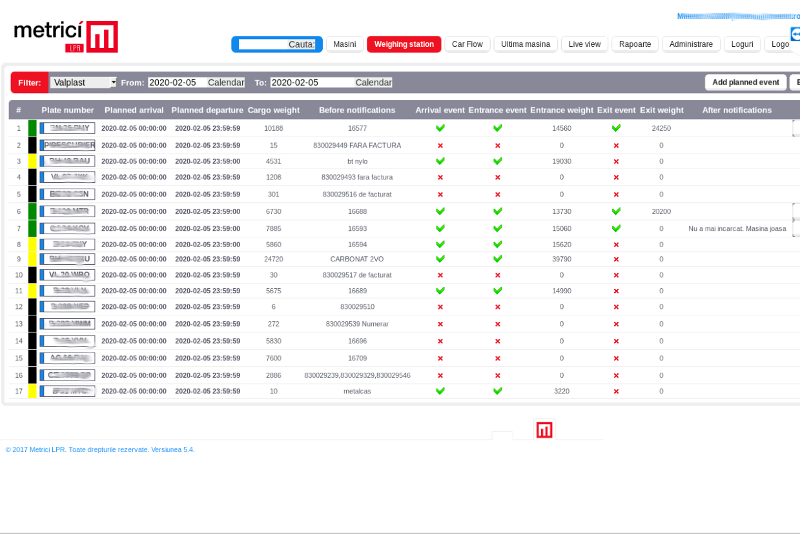 Valplast · case study
Weighing and access automated at a PVC producer
Romania's leading PVC producer, with warehouses and distribution centres across the country, piloted full automation at one facility: three LPR cameras, pre-registered vehicles with expected cargo weight, and an exit barrier that stays closed when the deviation exceeds the configured threshold.
3 LPR camerasPre-registered vehiclesDeviation alarmsRollout planned
Read the case →
 Doraly · case study
Every vehicle across a 22-hectare distribution park
Romania's largest wholesale commercial park — 57,000 m² of building surface, 850+ companies, 3,000 parking places — has no barriers to count with. Eight LPR cameras cover all entrances and exits, and custom reports break visitors down by county and visit frequency.
8 LPR cameras22 hectares850+ companiesCustom reports
Read the case →
 Truck yard · case study
500+ truck spaces monitored by cameras
A truck parking facility in Bulgaria replaced walk-round counts with Metrici PPD: one overhead camera reports the status of many spaces, so occupancy and availability are known at the gate instead of on the radio.
500+ spacesPPD per-space statusCamera-based
Read the case →
Also relevant: industrial sites, campuses and freight corridors
The same platform handles vehicle access and yard traffic where heavy vehicles share space with people: Tenaris Silcotub industrial park, Valeo Industrial Park, Philips Factory Orăștie and the Hermès business campus. Where weighing happens on public roads, the Toll Station Module applies the same plate-to-transaction logic, and city-scale vehicle and freight movement is covered by our smart city analytics.
Products and integrations
Modules a logistics deployment typically combines
Licensed per camera and per engine, on the same platform. Start with the gate or the weighbridge, add docks and yard later without migration.
Metrici LPR
Plate recognition for 57+ countries and syntaxes, front and rear, free flow or triggered, with image and event per read.
LPR Weighing Module
Plate-to-weight sync, overload and entry-vs-exit deviation alerts, whitelist access, any industrial scale.
Metrici PPD
Parking Place Detector: free or occupied status per dock, bay or yard slot from one overhead camera.
Metrici Line Counter
Directional counts across virtual lines: trucks and vans by class, per lane, per hour, per gate.
Metrici Area Counter
Occupancy and counting inside defined zones: aprons, staging lanes, yard rows, restricted areas.
Container Code Recognition
ISO container and trailer codes read at the gate and matched to the plate carrying them.
QR & 2D Code Reader
Labels, waybills and passes read from the video feed for identification and automated checks.
LPR Parking Module
Access rights, tariffs, subscriptions and reporting for staff, visitor and trailer parking at the depot.
Metrici LED Display
Plate, weight, direction, ramp or dock assignment shown to the driver live at the gate or scale.
Metrici LAN Controller
Scale inputs, loops, barriers, relays and lights controlled over the network from one device.
Metrici MultiController
LPR bridged with Wiegand and RFID access control in one industrial device for gates and doors.
Metrici Car Kit
Mobile LPR for yard and perimeter patrols, reading plates on the move from a service vehicle.
Integration and data ownership
You keep your own stack: Metrici publishes events and statistics rather than holding them, and the same interface that drives your barrier can drive your middleware.
RTSP / ONVIF camerasHTTP POST / JSON eventsDirect SQL accessCSV · XLS · PDF exports
TMS · WMS · ERP platformsIndustrial scales — any brandBarix Barionet Metrici firmware
Barrier, relay and loop controlWiegand / RFID access systemsTraffic lights and LED signage
Email & SMS alarmsDedicated colour-coded GUIWindows · Linux · edge serversGDPR retention & role-based access
Next step
Automate your logistics operation
Send us a site plan, the scale model, a camera list or just your daily truck count. We will show you what the engines measure at your gate, weighbridge and docks, and scope the cameras, servers and licences a phased rollout would need.
01 · SCOPE
30-minute technical call
Your gates, scales, docks and current cameras, plus the systems the data must reach. We identify which engines apply and what your existing cameras can already support.
02 · PROVE
Pilot on one gate and one scale
Plate-to-weight records, dock occupancy and gate counts measured live on your site, with the reports you keep either way.
03 · ROLL OUT
Phased deployment across sites
Staged expansion with acceptance criteria per phase, integration into TMS, WMS and ERP, and training for gate and weighing operators.